- Home
- Meditation
Meditation for Migraine Relief: Calm Your Nervous System & Reduce Attacks
Meditation for migraine relief can help calm your nervous system and reduce stress-driven attacks. When practiced consistently, it may lower migraine frequency, improve recovery, and make attacks easier to manage.
Migraine is a neurological condition influenced by brain excitability and stress response. Learning how to regulate your nervous system through simple meditation techniques can become a powerful complementary strategy alongside medication and prevention.
Below I’ll show you how meditation works, when to use it, and how to build a realistic routine that supports long-term stability.
Why Meditation Helps Migraine
If you live with migraine, you already know this isn’t just a headache. It’s a full nervous system event.
When you’re stressed, your brain floods your body with cortisol and other chemicals that can constrict blood vessels and heighten pain sensitivity - triggering or worsening a migraine. When your nervous system is overloaded, stressed, or constantly on edge, attacks become easier to trigger and harder to control.
Meditation for migraine relief is not a cure. It is a regulation tool. The effects are cumulative over time.
When used consistently, meditation can:
- Reduce stress reactivity
- Improve recovery after attacks
- Lower attack frequency for some people
- Help you cope better during pain
This is not about sitting cross-legged for an hour. It’s about learning how to calm your brain — intentionally.
Migraine is a neurological disorder involving altered brain excitability and sensory processing changes.
When you are stressed, your brain increases cortisol and inflammatory signaling. That raises your migraine threshold risk.
Meditation activates your parasympathetic nervous system — your “rest and restore” state.
Over time, this may:
- Reduce central sensitization
- Lower muscle tension
- Improve sleep quality
- Improve emotional regulation
- Reduce stress-triggered attacks
If you haven’t yet explored how migraine works neurologically, read → Patient Education on Migraine Headaches
Understanding the biology makes meditation make sense.
What the Research Says
Clinical studies on mindfulness-based stress reduction (MBSR) show:
- Reduced migraine days
- Improved quality of life
- Reduced medication reliance for some participants
Meditation is not a replacement for acute treatment.
It is a complementary layer.
If you need immediate attack guidance, see → Migraine Relief
If you’re working on long-term reduction, see → Migraine Prevention
Meditation fits inside prevention — not instead of it.
When to Use Meditation for Migraine
There are three ideal windows:
Daily Regulation (Best Long-Term Results)
The most commonly recommended session length is 20 minutes, but even 5–10 minutes per day can gradually stabilize your nervous system.
This is where real change happens.
Early Warning Signs
During prodrome (neck stiffness, mood changes, light sensitivity), meditation may reduce escalation.
Learn those early phases here → 4 Phases of Complex Migraine
During an Attack
Yes, you can meditate during pain.
But your goal shifts — from eliminating pain to reducing suffering and muscle tension.
Lie down. Dark room. Slow breath. Guided audio.
And take your prescribed medication if needed.
Simple Meditation Techniques You Can Start Today
These methods are effective even if you’ve never meditated before. You do not need to be “good” at meditation. You just need consistency.
1. Breath-Focused Regulation
Inhale for 4.
Exhale for 6.
Longer exhales calm the nervous system.
2. Body Scan for Tension Release
Slowly scan from head to toe.
Relax your jaw, shoulders, neck — common migraine tension zones.
Bringing awareness to the area helps release it.
3. Compassion Based Meditation
Silently repeat:
"I am safe. This will pass."
Emotional stress amplifies pain. Compassion reduces resistance.
4. Acceptance Practice
Observe the pain instead of fighting it.
Counterintuitive — but effective.
How to Build a Realistic Meditation Routine
You do not need perfection.
Start with:
- 5 minutes daily
- Same time each day
- Same space
- Gentle consistency
Pair it with sleep hygiene and hydration.
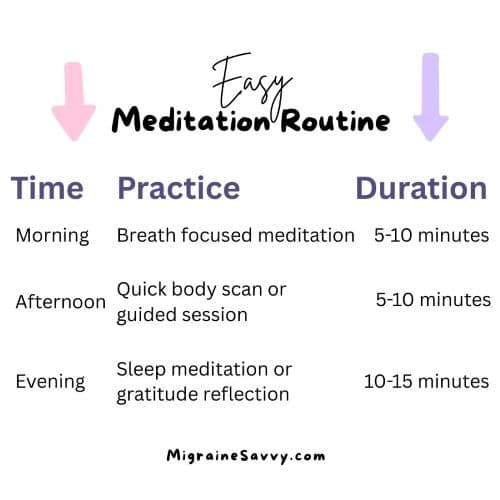
Realistic Daily Meditation Plan
This simple rhythm helps train your nervous system through repetition.
Meditation works best when layered with:
- Structured prevention → Migraine Prevention
- Trigger awareness → Migraine Triggers
- Practical support → Migraine Help
Pro Tip: You don’t have to meditate perfectly. You just have to show up consistently.
Small daily regulation compounds.
Free Meditation Scripts to Get Started
If you’d like structure, I’ve created two free downloadable meditation scripts:
- Anger Management Meditation
- A Migraine Meditation Just for You
→ Download the Free Migraine Meditation Scripts
Use them for 14 days and track how you feel.
Want a Structured Meditation Program?
If you want deeper guidance designed specifically for migraine sufferers, my full course includes:
Meditations and Energetic Healing for Migraine Sufferers
- 10 guided audio meditations
- Nervous system calming exercises
- Visualization practices
- Emotional regulation tools
- Downloadable materials

This is for you if:
- Stress is a major trigger
- Anxiety amplifies your attacks
- You struggle to calm your mind during pain
It does not replace medication.
It supports regulation.
Personal Tips from My Own Experience
Meditation became important for me when I realized stress made everything worse.
Here’s what helped:
- Trust that attacks pass.
- Create a prepared “migraine space.”
- Keep water, medication, ice, and eye mask nearby.
- Use one consistent mantra.
- Relax jaw and shoulders first.
- If you fall asleep — that’s a win.
You don’t need to meditate perfectly.
You need to show up and meet yourself with compassion.

Common Questions
Can meditation really reduce migraines?
It can reduce frequency or severity for some people. Results vary.
How long before I see results?
Most studies show measurable change after 8 weeks of consistent practice.
Can I rely only on meditation?
No.
Use acute treatment when needed. See → Migraine Medications
Meditation supports — it does not replace.
A Final Word
Meditation for migraine relief is about control — not curing.
When you calm your nervous system regularly, you reduce overall load.
Less load often means fewer escalations.
Not always.
Not perfectly.
But meaningfully.
If meditation was important for you, it may become important for someone else too.
And even if it doesn’t reduce attack frequency dramatically, it can reduce suffering.
That matters.
More Resources on Meditation for Migraine Relief
Guided & Practical Techniques
Science & Education
Mindfulness & Tools
Perspective & Inspiration
Ready to take the next step?
Choose the next step that fits where you are right now.



CATEGORIES
Migraine Types
Symptoms
Migraine Causes
Migraine Triggers
Associated Migraine Conditions
Treatment Options
Prevention Strategies
Medications
Migraine Relief
Complementary Treatments
Migraine Help
Food & Diets
Recipes
Meditation
Your Migraine Stories
Patient Education on Migraine Headaches
MORE SUPPORT
Free Printable Downloads
Migraine Relief Secrets 5-Week eCourse
Free Migraine Pain Management Workshop
Free Module 1 - Migraine Pain Management Course
Free Brain Health Challenges
NEWSLETTER
Practical Tips & Tools for
migraine prevention
Get weekly updates.
CONTACT ME
contact-me@migrainesavvy.com
PRIVACY // TERMS & DISCLAIMERS // REFUND POLICY // AFFILIATE DISCLOSURE // ADVERTISE // CONTACT // SITEMAP // DONATE // SHOP
Medical Disclaimer: The information on MigraineSavvy.com is provided for educational purposes only and should not be used as a substitute for professional medical advice or psychological advice, diagnosis, or treatment. Always consult your healthcare provider before making any healthcare decisions. No content on this website establishes a doctor-patient relationship, and MigraineSavvy.com does not provide medical advice or assume any liability for how the information is used.
By using this website, you agree to the Terms of Use and Privacy Policy.
Copyright © 2010- MigraineSavvy.com. All rights reserved regardless of links or attributions. Content may not be reproduced in any form.

Powered by Solo Build It