- Home
- Causes
Migraine Causes: Understanding the Biology Behind the Attacks
Migraine causes are complex biological processes occurring inside the brain and nervous system. They are not the same as triggers.
Understanding this distinction is essential. A trigger may initiate an attack, but the underlying cause involves abnormal neurological signaling, genetic susceptibility, and chemical changes within the brain.
Migraine is now recognized as a neurovascular disorder involving brain hyperexcitability, sensory processing dysfunction, and inflammatory signaling. It is not simply a vascular headache.
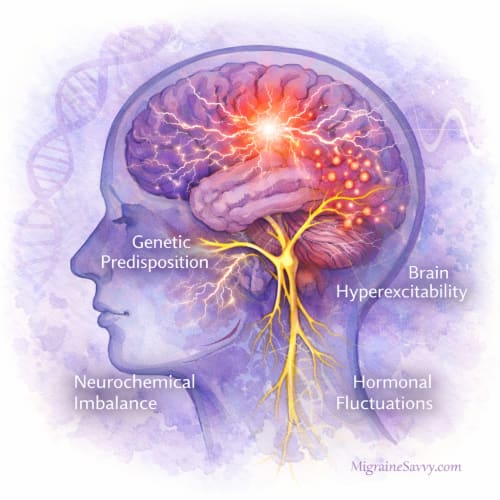 Migraine causes involve underlying neurological susceptibility including genetic factors, brain hyperexcitability, chemical signaling changes and hormonal influence
These internal mechanisms create susceptibility. Triggers may influence when an attack begins, but the biological foundation exists within the nervous system itself.
Let’s break this down clearly.
What Actually Causes a Migraine?
The exact cause of migraine is not fully understood. However, research consistently shows that migraine involves inherited susceptibility and abnormal neurological signaling within the brain and nervous system.
Migraine is associated with genetic vulnerability, heightened brain excitability, trigeminal nerve activation, neurochemical fluctuations, hormonal influences, and inflammatory signaling. These mechanisms interact to create a nervous system that is more reactive and more easily activated.
Migraine is not caused by weakness, stress alone, or personality traits. It is a neurological disease with measurable biological mechanisms.
Genetic Factors in Migraine
Approximately two-thirds of people with migraine report a family history.
Twin studies suggest that genetics contribute to roughly 40–60% of migraine risk. Migraine with aura appears to have a stronger genetic component than migraine without aura.
Researchers have identified multiple gene variants associated with migraine susceptibility. These genes often influence:
- Ion channel regulation
- Glutamate transmission
- Neuronal excitability
Rare inherited conditions such as familial hemiplegic migraine involve specific gene mutations affecting calcium channel function.
The TRESK gene mutation (identified in 2010) was one of the first clearly linked migraine gene discoveries. However, most migraine cases are not caused by a single gene. Instead, migraine is considered a polygenic disorder, meaning multiple small genetic influences combine to increase risk.
Genetics create vulnerability - they do not guarantee attacks.
Brain Chemistry & Neurological Mechanisms
Migraine begins in the brain, not in the blood vessels.
Modern research shows that migraine involves a process called cortical spreading depression (CSD), a wave of electrical disturbance that travels across the cortex and is strongly associated with migraine aura. Even in migraine without aura, similar patterns of hyperexcitability may occur.
During an attack:
- Brain cells become hyperexcitable.
- The trigeminal nerve system becomes activated.
- Inflammatory neuropeptides such as CGRP are released.
- Pain pathways amplify sensory signals.
These processes produce:
- Head pain
- Sensitivity to light and sound
- Nausea
- Cognitive disruption
Serotonin levels also fluctuate during attacks. Although migraine was once thought to be purely vascular, it is now understood as a complex neurological process involving altered pain regulation and sensory processing.
The Role of the Trigeminal Nerve System
The trigeminal nerve is a primary pain pathway in the head and face.
When activated during migraine, it:
- Releases inflammatory substances.
- Sensitizes surrounding nerves.
- Amplifies pain perception.
This helps explain why migraine pain can feel throbbing, pulsating, and widespread.
Modern migraine medications such as triptans and CGRP inhibitors specifically target this pathway.
Understanding this mechanism reinforces that migraine is not simply caused by tension or muscle tightness.
Hormonal Influences on Migraine Causes
Hormones, particularly estrogen, significantly influence migraine patterns.
Fluctuations in estrogen can affect serotonin signaling, neuronal excitability, and pain sensitivity. This helps explain why migraine:
- Is more common in women
- Often worsens before menstruation
- May change during pregnancy
- Can shift during perimenopause
Hormones do not cause migraine independently. They interact with an already sensitive neurological system.
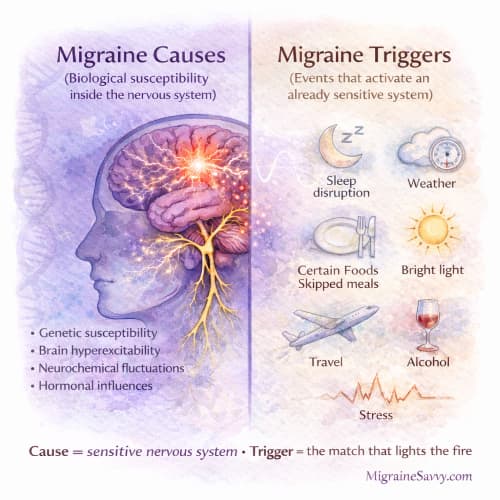 Migraine causes involve internal neurological susceptibility, while triggers are events that activate an already sensitive nervous system
Causes vs Triggers: Understanding the Difference
This is where confusion often occurs.
Migraine Causes
Biological mechanisms inside the brain and nervous system that create susceptibility.
Examples:
- Genetic predisposition
- Brain hyperexcitability
- Neurochemical imbalance
- Hormonal fluctuations
Migraine Triggers
External or internal events that activate the underlying migraine process.
Examples:
- Sleep disruption
- Stress
- Weather changes
- Certain foods
- Skipped meals
- Bright light
Triggers do not cause migraine in someone who does not have migraine disease.
They activate an already sensitive neurological system.
Think of it this way:
Cause = a sensitive nervous system
Trigger = the match that lights the fire
But without an underlying neurological predisposition, those triggers would not produce migraine.
Triggers come first in time.
The cause is always present in the background.
If you want a deeper breakdown, read → Migraine Triggers
Understanding the Difference: A Quick Recap
Migraine discussions often mix up causes, triggers, and symptoms, but these are three different parts of the migraine process.
Causes are the underlying neurological mechanisms that make a person susceptible to migraine. These include genetic factors, brain hyperexcitability, and neurochemical changes in the nervous system.
Triggers are internal or external factors that activate the migraine process in someone who already has this susceptibility. Common triggers include stress, sleep disruption, hormonal shifts, certain foods, weather changes, or bright lights.
Symptoms are the physical and neurological effects that occur during a migraine attack. These may include head pain, nausea, visual disturbances, dizziness, brain fog, or sensitivity to light and sound.
Understanding the difference helps you recognize patterns, identify triggers, and manage your attacks more effectively.
Can Migraine Be Seen on a Brain Scan?
Migraine is a functional neurological disorder involving changes in brain signaling and electrical activity rather than structural damage.
Routine MRI or CT scans are typically normal between attacks. Diagnosis is based on symptom patterns, not imaging findings.
Advanced research imaging shows functional differences in migraine brains, but these are not used in everyday diagnosis.
This reinforces that migraine causes are biological processes — even when scans appear normal.
Psychological Conditions & Migraine
Migraine is associated with higher rates of anxiety, depression, and bipolar disorder. These are considered comorbid conditions — not direct causes.
Migraine causes arise from neurological chain reactions involving brain signaling, neurochemicals, and genetic susceptibility.
Living with chronic neurological pain can increase vulnerability to mood disorders. At the same time, overlapping brain chemistry pathways may contribute to both conditions.
Depression does not cause migraine. The relationship is complex and bidirectional.
Why Understanding Migraine Causes Matters
Understanding the biological cause helps you:
- Stop blaming yourself and recognize that migraine is not some psychological weakness
- Recognize genetic vulnerability
- Distinguish triggers from causes
- Make informed treatment decisions
- Understand why prevention is layered
Migraine is not just “bad headaches.”
It is a neurological condition involving complex brain signaling patterns that require targeted management.
The Bottom Line
Migraine is caused by a genetically influenced, hyper-responsive nervous system.
Triggers activate it. Hormones influence it. Stress worsens it. But the underlying condition is neurological.
You did not cause your migraine.
You can, however, learn how to reduce trigger load, stabilize your nervous system, and build a layered prevention strategy.
Understanding the difference between cause and trigger is the first step.
More to Read on Migraine Causes
Understanding What’s Happening in the Brain
Hormones & Life Stage Changes
Food, Digestion & Biological Contributors
Less Common or Debated Causes
Children & Special Situations
- Meditation for Migraine Relief & Stress Reduction (as nervous system regulation support)
Ready to take the next step?
Choose the next step that fits where you are right now.



CATEGORIES
Migraine Types
Symptoms
Migraine Causes
Migraine Triggers
Associated Migraine Conditions
Treatment Options
Prevention Strategies
Medications
Migraine Relief
Complementary Treatments
Migraine Help
Food & Diets
Recipes
Meditation
Your Migraine Stories
Patient Education on Migraine Headaches
MORE SUPPORT
Free Printable Downloads
Migraine Relief Secrets 5-Week eCourse
Free Migraine Pain Management Workshop
Free Module 1 - Migraine Pain Management Course
Free Brain Health Challenges
NEWSLETTER
Practical Tips & Tools for
migraine prevention
Get weekly updates.
CONTACT ME
contact-me@migrainesavvy.com
PRIVACY // TERMS & DISCLAIMERS // REFUND POLICY // AFFILIATE DISCLOSURE // ADVERTISE // CONTACT // SITEMAP // DONATE // SHOP
Medical Disclaimer: The information on MigraineSavvy.com is provided for educational purposes only and should not be used as a substitute for professional medical advice or psychological advice, diagnosis, or treatment. Always consult your healthcare provider before making any healthcare decisions. No content on this website establishes a doctor-patient relationship, and MigraineSavvy.com does not provide medical advice or assume any liability for how the information is used.
By using this website, you agree to the Terms of Use and Privacy Policy.
Copyright © 2010- MigraineSavvy.com. All rights reserved regardless of links or attributions. Content may not be reproduced in any form.

Powered by Solo Build It