- Home
- Migraine Education
- Chronic Daily Headache Treatment
Chronic Daily Headache Treatment: An 8-Step Plan That Actually Works
Chronic daily headache treatment requires more than random supplements and trial-and-error medication changes. If you experience headaches 15 or more days per month, you need a structured plan built on diagnosis, prevention, and careful tracking.
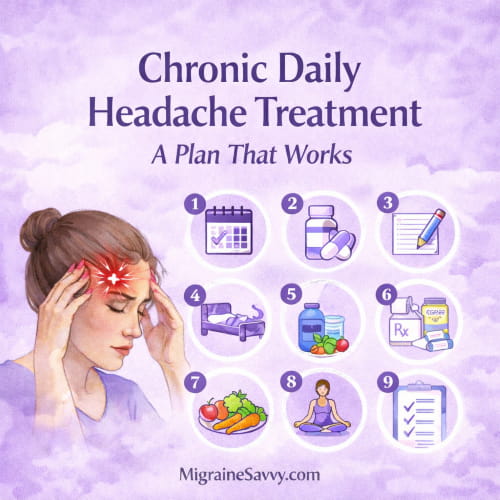 Chronic daily headache treatment begins with accurate diagnosis, medication review, and layered prevention planning
Many chronic daily headaches are linked to medication overuse, poorly managed migraine, tension-type headache, or a combination of both.
Before trying another supplement, start with clarity.
Let’s walk through this step by step.
What Is Chronic Daily Headache?
Chronic daily headache is defined as:
- Headache occurring 15 or more days per month
- Lasting at least 3 months
- Often overlapping with chronic migraine
It is not a single diagnosis. It describes frequency.
The underlying type determines treatment.
Chronic Daily Headache vs Chronic Migraine
Many people use these terms interchangeably, but they are not identical.
Chronic migraine includes:
- 15 or more headache days per month
- At least 8 days with migraine features
- Throbbing pain, nausea, sensory sensitivity, or aura
Chronic tension-type headache usually presents as:
- Pressure-like pain
- Bilateral tightness
- Less nausea and light sensitivity
Some patients have mixed patterns.
This distinction matters because treatment options differ. For example:
- Chronic migraine may qualify for Botox.
- Chronic tension-type headache typically does not.
- Medication strategies and preventive layering vary.
If you are unsure which category fits you, read → Types of Migraines
Common Causes of Chronic Daily Headache
Chronic daily headaches are often driven by:
- Medication overuse
- Uncontrolled chronic migraine
- Chronic tension-type headache
- Poor sleep regulation
- Stress overload
- Hormonal shifts
- Neck and musculoskeletal strain
Most people have more than one contributing factor.
That is why a structured plan matters.
Medication Overuse Headache
Medication overuse headache is one of the most common causes of chronic daily headache.
If you use acute medications more than:
- 10 days per month for triptans or combination pain relievers
- 15 days per month for simple analgesics
Your brain can become sensitized.
The cycle often looks like this:
Headache → Medication → Temporary relief → Rebound headache → More medication
Breaking this pattern usually requires medical supervision.
If you suspect this applies to you, speak with your doctor before stopping medication abruptly.
Lifestyle & Biological Contributors
Once medication overuse is addressed, additional contributors may include:
- Dehydration or electrolyte imbalance
- Poor sleep timing
- Digestive disturbances
- Histamine sensitivity
- Hormonal fluctuations
- Chronic stress activation
These factors rarely act alone.
They accumulate and lower your migraine threshold over time.
This is why small, consistent improvements often produce better results than extreme elimination strategies.

What Your Doctor Should Evaluate
A thorough chronic daily headache treatment plan includes:
- Confirming correct diagnosis
- Ruling out secondary causes
- Reviewing current and past medications
- Identifying comorbid conditions
- Assessing prior preventive attempts
- Creating a structured plan with follow-up
If your appointments feel rushed or unclear, read → Headache Doctor Appointments: How to Be More Effective
The 8-Step Chronic Daily Headache Treatment Plan
Here is a practical framework.
Step 1: Confirm the Diagnosis
Ensure red flags and secondary causes are ruled out.
Step 2: Address Medication Overuse
Work with your doctor on a safe reduction plan.
Step 3: Begin Structured Tracking
Track frequency, duration, medications, sleep, and potential triggers. See my → Trigger Trackers
Step 4: Stabilize Sleep
Go to bed and wake at consistent times, even on weekends.
Step 5: Regulate Hydration & Nutrition
Eat regularly. Avoid long fasting gaps. Balance electrolytes.
Step 6: Layer Preventive Strategies
Prevention may include:
- Prescription preventives
- Botox (for chronic migraine)
- CGRP medications
- Behavioral therapy
If you are considering Botox, read → Does Botox Help with Migraines?
Step 7: Address Stress & Nervous System Load
CBT, biofeedback, and meditation have strong evidence in chronic headache management.
See → Meditation for Migraine Relief
Step 8: Schedule Follow-Up
Chronic daily headache treatment requires adjustment... regularly.
When Prevention Fails
If you have already tried:
- Multiple preventive medications
- Lifestyle stabilization
- Supplements
And you still experience near-daily headaches, escalation may include:
- Botox injections
- CGRP therapies
- Combination preventive strategies
- Referral to a headache specialist center
Chronic daily headache treatment sometimes requires layered medical management.
This is not failure.
It is escalation.
Psychological Load & Chronic Headache
Living with near-daily pain increases:
- Anxiety
- Hypervigilance
- Sleep disruption
- Pain amplification
Chronic pain changes how your brain processes threat and stress.
CBT and structured nervous system regulation can reduce suffering, even if they do not eliminate pain entirely.
Pain is neurological.
But suffering is influenced by stress circuits.
Addressing both improves outcomes.
Red Flags: When Headache Is Not “Just Migraine”
Seek urgent medical evaluation if you experience:
- Sudden worst headache of your life
- Progressive neurological weakness
- Fever and stiff neck
- Headache after head injury
- New headache after age 50
Most chronic daily headaches are primary neurological disorders.
However, new, severe, or rapidly changing symptoms should always be evaluated immediately.
When to See a Headache Specialist
I'm going to speak frankly here.
If your headaches are getting worse instead of better, that is not something to ignore.
If you are taking your prescribed medication correctly and still experiencing breakthrough pain, you deserve a proper evaluation.
If you suspect medication overuse but feel unsure how to safely reduce it, do not try to manage that alone.
If you have tried two or more preventive treatments and nothing has meaningfully reduced your frequency, it may be time to escalate care.
And if your diagnosis feels unclear, or your symptoms do not fit neatly into one category, that is exactly when a headache specialist can help.
You should consider seeing a neurologist or board-certified headache specialist if:
- Your headaches are increasing in frequency or intensity
- You experience breakthrough pain despite current prescribed treatment
- Medication overuse may be part of the cycle
- Preventive therapies have failed
- Neurological symptoms are recurring or changing
Specialist care is not a sign that you have failed.
It is a sign that you are ready for a more precise strategy.
Sometimes the difference between “coping” and “improving” is simply getting the right level of expertise.
Learn Directly from Leading Migraine Specialists
Living with migraine can feel overwhelming, especially when treatments don’t work the way you hoped or when people around you don’t understand the condition.
If you are struggling with frequent migraine attacks, learning directly from experienced neurologists and headache specialists can provide valuable insight into what may help.
Each year, the Migraine World Summit features interviews with leading migraine neurologists, researchers, and patient advocates to discuss the latest developments in migraine science and treatment.
During the event, experts share practical information about:
- migraine prevention strategies
- treatment advances and medications
- lifestyle and trigger management
- emerging migraine research
- ways to improve quality of life with migraine
The summit streams free online for one week each year, allowing you to watch the interviews from home.
If you prefer to watch the sessions at your own pace, lifetime access is also available.
→ See the migraine experts speaking this year

A Clear Path Forward
Chronic daily headache treatment is not about finding one miracle supplement.
It is about:
- Accurate diagnosis
- Reducing medication overuse
- Layered prevention
- Nervous system stability
- Ongoing evaluation
Small changes compound over time.
You do not need to fix everything at once.
You need a structured plan.
If you want step-by-step prevention guidance, see → Migraine Pain Management Course
Ready to take the next step?
Choose the next step that fits where you are right now.



MIGRAINE EDUCATION Related Articles





CATEGORIES
Migraine Types
Symptoms
Migraine Causes
Migraine Triggers
Associated Migraine Conditions
Treatment Options
Prevention Strategies
Medications
Migraine Relief
Complementary Treatments
Migraine Help
Food & Diets
Recipes
Meditation
Your Migraine Stories
Patient Education on Migraine Headaches
MORE SUPPORT
Free Printable Downloads
Migraine Relief Secrets 5-Week eCourse
Free Migraine Pain Management Workshop
Free Module 1 - Migraine Pain Management Course
Free Brain Health Challenges
NEWSLETTER
Practical Tips & Tools for
migraine prevention
Get weekly updates.
CONTACT ME
contact-me@migrainesavvy.com
PRIVACY // TERMS & DISCLAIMERS // REFUND POLICY // AFFILIATE DISCLOSURE // ADVERTISE // CONTACT // SITEMAP // DONATE // SHOP
Medical Disclaimer: The information on MigraineSavvy.com is provided for educational purposes only and should not be used as a substitute for professional medical advice or psychological advice, diagnosis, or treatment. Always consult your healthcare provider before making any healthcare decisions. No content on this website establishes a doctor-patient relationship, and MigraineSavvy.com does not provide medical advice or assume any liability for how the information is used.
By using this website, you agree to the Terms of Use and Privacy Policy.
Copyright © 2010- MigraineSavvy.com. All rights reserved regardless of links or attributions. Content may not be reproduced in any form.

Powered by Solo Build It