- Home
- Medications
- Cgrp Drugs for Migraine
CGRP Drugs for Migraine: A New Era in Treatment
CGRP drugs for migraine are one of the most exciting breakthroughs in decades. Unlike older medications that were "borrowed" from other conditions, these drugs were designed specifically for migraine prevention and treatment.
For many people who have struggled with limited or ineffective options, CGRP inhibitors represent real hope. While they are not a cure, studies show they can reduce the frequency and impact of migraine attacks, and for some, even transform daily life.

Disclaimer: This article is for educational purposes only and not a substitute for medical advice. Always talk to your healthcare provider before starting or changing migraine medications.
What Are CGRP Drugs for Migraine?
CGRP drugs are just one category within the growing field of migraine medications.
CGRP stands for calcitonin gene-related peptide. This protein is released during migraine attacks and plays a key role in pain transmission. High CGRP levels can make the trigeminal nerve hypersensitive, which triggers hallmark migraine symptoms such as:
- Severe head pain
- Light and sound sensitivity
- Nausea and vomiting
The trigeminal nerves are responsible for sensations in the face/head and control actions like chewing and biting.
CGRP inhibitors work by blocking the action of this peptide, reducing migraine activity at its source.
There are two main types:
- Monoclonal antibodies (injections or infusions used for prevention)
- Gepants (oral medications, used for acute attacks or prevention depending on the drug)
FDA-Approved CGRP Drugs
Here are the current FDA-approved options:
Monoclonal Antibodies (Preventive Treatments)
- Aimovig (erenumab-aooe) - approved May 2018
- Ajovy (fremanezumab) - approved Sept 2018
- Emgality (galcanezumab-gnlm) - approved Sept 2018
- Vyepti (eptinezumab-jjmr) - approved February 2020 (first quarterly IV infusion)
Gepants (Oral CGRP Receptor Antagonists)
- Ubrelvy (ubrogepant) - approved Dec 2019 (acute treatment)
- Nurtec ODT (rimegepant) - approved Feb 2020 (acute treatment & preventive use)
- Qulipta (atogepant) - approved Sept 2021 (preventive treatment)
These medications have given patients more flexibility: injections for long-term prevention, or tablets for fast relief and daily prevention options.
Gepants are small molecules that bind to the CGRP receptor, blocking the release of CGRP. These CGRP receptor antagonists do not cause vasoconstriction; therefore, they may be an alternative for migraine patients who are unable to take triptans due to the vasoconstrictive effects.
~ Goadsby [4]; Lipton [5]; Lipton [6]; Dodick [7]
How Do CGRP Drugs Work?
During a migraine, CGRP binds to receptors on nerves around the brain and blood vessels, amplifying pain signals.
Monoclonal antibodies "mop up" CGRP or block its receptor before it can trigger migraine pain.
Gepants are small molecules that block the CGRP receptor. Unlike triptans, they don’t cause vasoconstriction, making them a safer option for people with cardiovascular concerns.
READ MORE
Acute treatments like gepants → Drugs for Treatment of Migraine: Best Acute Migraine Medications
Prevention → The Best Migraine Prevention Medications
What Do the Studies Show?
Clinical trials of CGRP drugs have shown impressive results:
- Many patients report 50% fewer migraine days per month.
- Some experience periods of being completely migraine-free.
- Benefits are often seen within the first 1–2 months of treatment.
For example:
- Aimovig trials: 40–50% of patients saw migraine days cut in half.
- Vyepti trials: Some reported improvements after just one infusion.
While results vary, these numbers are promising compared to older preventive options.
>> You can see the exact results here: ALD403 and LY2951742).
Tip for Migraine Management
Keeping track of all your options can be overwhelming. That’s why I created a simple Printable Migraine Medication List you can take to your doctor. Compare treatments side-by-side, mark your preferences, and make decisions with confidence.
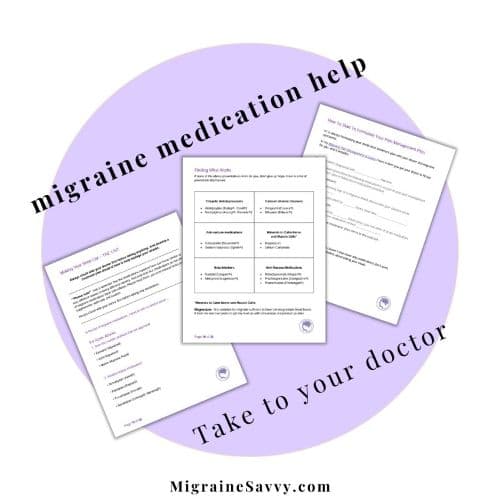
Get Your Printable Migraine Medication List
Easily compare options, mark your preferences, and take to your doctor.
Price: $4.99 - Instant Download
>> Get Your Copy Now <<
Potential Drawbacks
As with all medications, there are trade-offs:
- Cost: These drugs can be expensive, though many insurance providers now cover them.
- Administration: Some require self-injections or IV infusions.
- Side effects: Generally mild, but can include constipation, injection-site reactions, or nausea.
- Not a cure: They reduce frequency and severity but may not stop attacks completely.
Still, for people with frequent or disabling migraines, CGRP drugs often make a significant difference.
Cost/insurance → Does Medicare Cover Migraine?
Making an Educated Decision
If you’re considering CGRP inhibitors:
- Track your migraine frequency before starting, so you and your doctor can measure progress.
- Ask about insurance coverage and co-pay programs.
- Discuss which type suits your lifestyle (monthly shot, quarterly infusion, or oral tablet).
Want an easy way to compare all your options?
Get Your Printable Migraine Medication List
Compare options, track what works, and take it to your doctor for better results.
>> Download your copy instantly <<
FAQs About CGRP Drugs
1. Are CGRP drugs better than triptans?
1. Are CGRP drugs better than triptans?
Answer: Not necessarily "better," but they work differently. Triptans are designed for acute attacks and constrict blood vessels, while CGRP drugs prevent migraines or treat them without vasoconstriction - making them safer for people with heart disease.
2. What’s the difference between monoclonal antibodies and gepants?
2. What’s the difference between monoclonal antibodies and gepants?
Answer: Monoclonal antibodies are longer-lasting preventive injections or infusions. Gepants are oral medications that work quickly, and some can be used for either prevention or acute treatment.
3. Are CGRP drugs safe long-term?
3. Are CGRP drugs safe long-term?
Answer: So far, studies suggest they are well-tolerated and safe for long-term use, but because they are relatively new, researchers continue to monitor side effects and outcomes.
Final Thoughts
CGRP drugs for migraine mark the first true migraine-specific treatments since triptans in the 1990s. They aren’t perfect, but they’ve changed the game for many people who once felt out of options.
If you’re considering these medications, work closely with your healthcare provider to find the best fit, and remember that combining preventive and acute strategies often works best.
Get Your Migraine Medication Prep Pack: Short List + Doctor Worksheets

Instant download - $4.99
<< Go back to Migraine Medications
Ready to take the next step?
Choose the next step that fits where you are right now.



MIGRAINE MEDICATIONS Related Articles




CGRP Drugs For Migraine Page Source:
1. Drugs.com (2018) CGRP Inhibitors. Available [online] at: https://www.drugs.com/drug-class/cgrp-inhibitors.html
2. Alder Biopharmaceuticals (2020) Pipeline: eptinezumab. Available [online] at: https://www.alderbio.com/pipeline/eptinezumab/
3. Practice Update (2019) 2019 Top Stories in Primary Care: The Year of the Migraine: Mabs vs Gepants. Available [online] at: https://www.practiceupdate.com/content/2019-top-stories-in-primary-care-the-year-of-the-migraine-mabs-vs-gepants/93766
4. Goadsby PJ, Dodick DW, Trugman JM, et al. Orally administered atogepant was efficacious, safe, and tolerable for the prevention of migraine: results from a phase 2b/3 study (S17.001). Neurology. 2019;92 (15 Suppl):S17.001.
5. Lipton RB, Croop R, Stock EG, et al. Rimegepant, an oral calcitonin gene–related peptide receptor antagonist, for migraine. N Engl J Med. 2019; 381(2):142-149.
6. Lipton RB, Dodick DW, Ailani J, et al. Effect of ubrogepant vs placebo on pain and the most bothersome associated symptom in the acute treatment of migraine: The ACHIEVE II randomized clinical trial. JAMA. 2019; 322(19):1887-1898.
7. Dodick DW, Lipton RB, Ailani J, et al. Ubrogepant for the treatment of migraine. N Engl J Med. 2019;381(23):2230-2241.
8. Migraine Again (2020) VYEPTI for Migraine Prevention Approved by FDA. Available [online] at: https://migraineagain.com/new-vyepti-for-migraine-prevention-approved-by-fda/ Accessed Feb. 20, 2020

%20levels%20increase%20in%20our%20blood%20and%20saliva%20when%20we%20have%20a%20migraine%20attack.%20These%20drugs%20could%20be%20new%20way%20forward%20to%20treat%20and%20prevent%20primary%20headache%20disorders%20like%20migraine.%20YAY!%20CGRP%20Drugs%20for%20Migraine%20Prevention%20%40migrainesavvy%20%23migrainerelief%20%23headacherelief)
CATEGORIES
Migraine Types
Symptoms
Migraine Causes
Migraine Triggers
Associated Migraine Conditions
Treatment Options
Prevention Strategies
Medications
Migraine Relief
Complementary Treatments
Migraine Help
Food & Diets
Recipes
Meditation
Your Migraine Stories
Patient Education on Migraine Headaches
MORE SUPPORT
Free Printable Downloads
Migraine Relief Secrets 5-Week eCourse
Free Migraine Pain Management Workshop
Free Module 1 - Migraine Pain Management Course
Free Brain Health Challenges
NEWSLETTER
Practical Tips & Tools for
migraine prevention
Get weekly updates.
CONTACT ME
contact-me@migrainesavvy.com
PRIVACY // TERMS & DISCLAIMERS // REFUND POLICY // AFFILIATE DISCLOSURE // ADVERTISE // CONTACT // SITEMAP // DONATE // SHOP
Medical Disclaimer: The information on MigraineSavvy.com is provided for educational purposes only and should not be used as a substitute for professional medical advice or psychological advice, diagnosis, or treatment. Always consult your healthcare provider before making any healthcare decisions. No content on this website establishes a doctor-patient relationship, and MigraineSavvy.com does not provide medical advice or assume any liability for how the information is used.
By using this website, you agree to the Terms of Use and Privacy Policy.
Copyright © 2010- MigraineSavvy.com. All rights reserved regardless of links or attributions. Content may not be reproduced in any form.

Powered by Solo Build It