- Home
- Migraine Education
- Migraine World Summit Highlights
Migraine World Summit Highlights Archive
Welcome to the Migraine World Summit Highlights Archive! Here you’ll find curated notes, favorite interviews, and key takeaways from past Migraine World Summit events. These highlights make it easy to explore what experts have shared about migraine management, treatments, and research, without watching every full session.
For the latest Summit, including free live interviews and lifetime access, visit the Migraine World Summit main page.

If you're new here read → How the Migraine World Summit Works for New Members
Full disclosure: I may earn a commission if you register through my link. I only recommend products and educational resources aligned with current migraine research and clinical practice.
Migraine World Summit Highlights Quick Links
2025 | 2024 | 2023 | 2022 | 2021 | 2020 | 2019 | 2018 | 2017 |
2017 - 2022 Migraine World Summit Highlights
2022 Migraine World Summit Highlights
Key Takeaways:
- Certain foods and supplements may help manage attack frequency.
- Nutrition and brain health strategies complement medical treatment.
>> Learn more about the Migraine World Summit
2021 Migraine World Summit Highlights
Key Takeaways:
- Understanding specific triggers reduces unnecessary worry.
- Environmental and lifestyle adjustments can support treatment plans.
>> Watch the Latest Migraine World Summit

2020 Migraine World Summit Highlights
Lyn Griffiths, PhD. - What are MTHFR gene mutations and how do they affect migraine?
Epigenetics. Genes play a role in methylation and there is a susceptibility gene for migraine. There are vascular genes to consider as well. Mutations are in 9% of the population - which means they would have double copies of the gene abnormality. Homocysteine levels will be increased in the blood if you have this gene!
You can take a supplement that increases certain B group vitamins - Folate and VIT B levels in the diet - will help it work faster. This can help to reduce migraine with aura. Green leafy vegetables will help. With double mutation - any food with vitamin B will help.
Potential Cure
There are a number of new treatments around now - Monoclonal antibodies - CGRP is one of these - with very good results.
Triptans aren’t effective for everyone - these aren’t cures for everyone who takes it. She thinks everyone is too different to be able to have one treatment for everyone. She wants to see targeted treatment for each individual.
Hemiplegic migraine - developed a ‘cure’ for that type of migraine. Diagnostic testing is now available for 1 of 3 known genes, and they are testing 20,000 other genes.
Sub-type of migraine with aura has a determined gene group.
She says this should help to diagnose people more effectively and then help with more targeted treatment choice(s).
In time, these two will go hand in hand for individuals. First find the gene combination and then be directed to targeted treatment.
Key Takeaways:
- Genetic testing can help guide treatment choices.
- CGRP antibodies provide new options for chronic migraine management.
>> Get Lifetime Access to the Summit
How Pain Works in the Migraine Brain - Patricia Pozo Rosich, MD, PhD
For my summary notes on Patricia Pozo Rosich's interview - click here.

2019 Migraine World Summit Highlights Encore
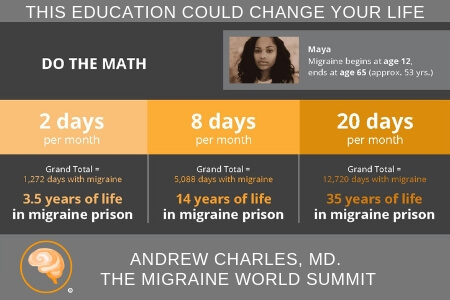
Dr. Andrew Charles, MD – The New Era of Migraine: Hope and Help
Dr. Andrew Charles' opening night talk, which the summit streamed for us in the encore, shocked and amazed me. Here's what shocked me:
- The hypotheses of migraine being a vascular disease... is wrong. The blood vessels do not dilate during an attack causing the pain.
This is a MUST WATCH talk... this single opening day encore, is worth the cost of admission!
In 15 minutes, you will understand SO much more about what a migraine is, what it does, and what you can do about it. Here's what amazed me:
THE GOOD NEWS is even if nothing is working for you right now… science has led us to a chemical cause of migraine, this shows we can develop migraine specific treatments, it raises the possibility of more targeted medicine to abort attacks based on an individual’s chemistry.
He leaves us with that message of optimism and hope. "This is a great time for migraine patients."
2019 Migraine World Summit Highlights
David Dodick, MD - Controlling Unresponsive Chronic Migraine
This is one of my absolute favorite talks from the Migraine World Summit (Day 7). Here's just a couple of key points he made...
First of all, I felt like crying about 3 times watching the talk with Dr. David Dodick.
I wanted to say "no headache centers here, no integrated clinics, no pain rehab program, just 25+ years of suffering with poorly prepared doctors guessing at drugs. And no internet" when I first got diagnosed. Back to the talk...
"What slips us into chronic migraine?"
So many migraine sufferers start out with episodic migraine and then they progress to chronic attacks. These are some risk factors:
- Frequency of headache and using acute medications - you should be reassessed if you suffer from 1 attack a week.
- Snoring – obstructive sleep apnea - or another sleep disorder.
- Obesity increases the risk by 5 fold. These patients get prescribed diet and exercise – low carb diet and exercise have good results. Exercise has found to be as effect as some of the prophylactic medication.
- Anxiety and depression increase the risk of it moving towards chronic by 3 times.
- Allodynia. Having Allodynia also increases your risk to become chronic. This means that central sensitization has increased and is on its way to becoming chronic. So you must initiate proper treatment as soon as possible.
- Other chronic pain syndromes.
- Genetics and the risk factors above.
- Other comorbid diseases.
Sub-optimal treatment of episodic attacks can increase the risk of migraines becoming chronic.
**Are your triggers actually triggers... or are they symptoms?**
Keep it simple in your diary:
- whether you had attack that day;
- if it was mild, moderate or severe;
- how long it lasted and
- what you took.
That's all the information he needs that informs his decision making on how he’s going to treat you. As far as triggers go... a trigger needs to be consistent - 75% of the time it must trigger an attack. You can chase your tail with triggers. His job is to raise our threshold so we can live a little more fully and not be afraid to go outside in the glaring sunlight or have a glass of red wine with dinner (so we’re not chasing imaginary triggers).
Proper migraine management will raise your threshold and not trigger you into attacks so often.
And then there’s that conversation around what is a trigger? Some triggers are actually the attack already starting in the brain and leading to symptoms within the attack process. Mood swings and food cravings (chocolate) can be part of the process, these frequent symptoms are not triggering. Make the triggers irrelevant just by raising your threshold.
There have been so many great talks on the Migraine World Summit, here's one more I wanted to share highlights on: Angel Moreno, Nurse Practitioner - Can A Keto Diet Help with Migraines?
Key Takeaways:
- Understanding migraine mechanisms enables more precise treatment.
- Lifestyle interventions can complement medical therapy.
2018 Migraine World Summit Highlights
Peter Goadsby, MD - The Keys to Finding New Treatments
For disability look at what the migraine takes away from you in detail.
I found this one really hard to summarize... I found it one of the best of the Migraine World Summit. So settle in, this is a long highlight!
Dr. Goadsby covered how patients can work more effectively with their doctor to communicate their experiences.
Your diary should represent what you are trying to say. It’s proof that you’ve got a lot of headache days. Make it summarized and be precise about what you need to say! Don’t bombard your doctor with a huge amount of information – but break it into small chunks.
Work out your message and work out how to support your message.
Your doctor needs and should take a good history to get the diagnosis right.
It’s not just about how bad the pain is, if you can communicate the disability it is causing you... a diary and a MIDAS form filled out… would be a good place to start.
Set realistic expectations.
There's NO CURE BUT your doctor will aim to reduce the attacks by 50% and resolve it in 2 hours. AND it doesn’t come back.
Commonly overlooked or under rated treatments:
- Dose for body weight
- Timing - TREAT WHEN MILD
- Time of exposure - you must give it time to work
Dosing by body weight for acute treatments example:
900 mgs of aspirin – under dosing for say a 70 kg person;
600-800 mgs of ibuprofen would be a more appropriate dose for ibuprofen and migraine;
Naproxen – 500-1000 mgs for a 70 kg adult would be a reasonable dose.
This bumps up against medication overdose.
It's important to use the medication when the pain is not yet full force – take when still mild.
The two most exciting things in the migraine world according to Dr. Goadsby at the Migraine World Summit this year are neuromodulation and the CGRP drugs.
Now we have CGRP and monoclonal antibodies that block the CGRP pathway that is activated in migraine.
Specifically designed to stop migraines.
CGRP itself is a peptide - 37 amino acids - and it circulates in the blood, it’s in the brain, involved in migraine process. It’s elevated in migraine.
If you infuse it in, will trigger migraine, if you block it, it will stop an attack. This means acute treatment.
Ability to either mop up GCRP or block the receptor.
On a preventive side, the CGRP acts at a receptor, a place that turns things on, so these antibodies are being designed to either block that receptor so that CGRP can’t get on there OR mop up the CGRP’s so they have no effect.
Monoclonal antibodies come from a single source. They have the immune path, the immune end, mutated away, so they don’t do anything immune. They don’t change the immune system itself.
And in doing that they reduce frequency and severity of migraine.
4 of them are in development – 3 currently filed in the US already. We can expect to hear more about that soon.
He talked about tolerability earlier, usually his slides on side effects are embarrassing – not in this case.
The current studies are proving very optimist with around 10,000 people testing this CGRP monoclonal antibodies treatment.
If you’ve failed with numerous medications, or have lost years… have hope because in the very near future you have a very good chance that this will help.
Have Hope! CGRP Antibodies Showing Promising Results.
Key Takeaways:
- Accurate communication with doctors is critical.
- Timing and dosage adjustments can improve outcomes.
>> Watch the Latest Migraine World Summit
Serene Branson - How to Thrive in Your Career Despite Migraine
Transient aphasia can look like a stroke.
I wrote about her episode back in 2011, here’s the link - Reporter Serene Branson: Not A Stroke Just A Migraine
This was a rare case example of Transient Aphasia that can look like a stroke that unfolded on live TV.
She never knew that her speech was so impaired until she watched it later. And after she got off the air, then she felt the numbness in her tongue and cheek and the arm – then she got scared.
It took her a year of researching and finding the right treatment and she now has it all under control. She’s currently a migraine advocate and journalist on CBS-2/KCAL-9 and a proud mom of 2.
This transient aphasia can occur in the aura phase or as part of a hemiplegic attack.

2017 Migraine World Summit Highlights
Golden Rule of Regularity
AND
Chocolate is NOT a trigger!
Dr. Goadsby – Top 10 Migraine Myths to Bust
The Myth Around Food Triggers
The hypothalamus drives you to eat. 6 - 8 hours is the premonitory phase... it’s biology.
Eat what you like and you’ll still get an attack. Symptoms are part of the biology of an attack. Chocolate is NOT a trigger!
He also said migraineurs will benefit from using the Golden Rule of Regularity with sleep, meals and exertion. Migraine biology wants us to be creatures of habit.
Diagnosis is straightforward. Management is tricky.
Dr. Andrew Charles – Recognizing and Treating 4 Phases of Migraine
Treat your prodrome with caffeine to help with fatigue, mood changes and brain fog!
The 4 phases of migraine. You need to know this to get your timing right. Soooo important.
If you get moody and irritable – your partner will notice. Use that as an early warning signal.
Neck pain is common in the premonitory phase of the attack, food cravings, light sensitivity, yawning, excessive urinating. For some fatigue is far worse than the pain. The phases merge and overlap and multiple brain regions are being affected.
He said to treat your prodrome with caffeine to help with fatigue, mood changes and brain fog!
In my personal experience, that only works effectively if you don't drink it every day. So - experiment.
Dawn Buse, PhD - Is Migraine Affecting Your Personal Life?
It's important to have a backup plan, AND plan ahead.
Children are resilient - talk with them and tell them what's going on.
Keep living your life!
Talk with those around you in advance. Have a backup plan, and plan ahead.
If you feel left out or isolated, as this condition can, get pictures and a video from a friend. Some participation is better than none for some of us.
Children are resilient – parents can talk it out with them; give them ways to help out – cold wash cloth, bring water, let them come and help.
Dr. Lawrence Newman - Best Acute Treatments You May Not Have Tried
It’s always a migraine! Take your abortive!
Only 5% of people are getting the right treatment!
Why triptans don’t work:
1. Doctor prescribes the wrong dose - there is a minimum and maximum dose. He suggests starting with the highest dose and watch for side effects and then reduce dose the next time.
2. Wrong formulation. You must also treat the nausea in most cases.
3. You wait too long. If you wait 40 minutes other pathways come into play and make the triptans less effective. Timing is everything.
Wrong dose and dosage causes us to take more pills.
You will need to have coping strategies and a plan for pain management setup to survive chronic migraines... until we find a cure!
Key Takeaways:
- Consistency in daily habits supports migraine management.
- Understanding myths vs. facts empowers better treatment decisions.
>> Watch this year's Migraine World Summit
Access the Most Current Summit Content
For the latest interviews, research, and strategies, check out my Cure Headaches section. This includes:
- Updated highlights and notes from recent interviews
- Practical strategies for chronic migraine management
- Easy-to-read summaries of key takeaways
>> See All Current Summit Highlights
Why Use the Highlights Archive?
- Quickly find practical advice from expert interviews.
- Stay up to date on emerging treatments and research.
- Reference previous years’ content to discuss options with your doctor.
- Connect each year’s insights to the latest Summit for continuous learning.
Want to watch the latest Migraine World Summit live or get lifetime access to all the interviews?


Medical Disclaimer: The information on MigraineSavvy.com is provided for educational purposes only and should not be used as a substitute for professional medical advice or psychological advice, diagnosis, or treatment. Always consult your healthcare provider before making any healthcare decisions. No content on this website establishes a doctor-patient relationship, and MigraineSavvy.com does not provide medical advice or assume any liability for how the information is used.
By using this website, you agree to the Terms of Use and Privacy Policy.
Copyright © 2010- MigraineSavvy.com. All rights reserved regardless of links or attributions. Content may not be reproduced in any form.
